
Rebel With a Care
A conversation with Asheville-based poet David Gate

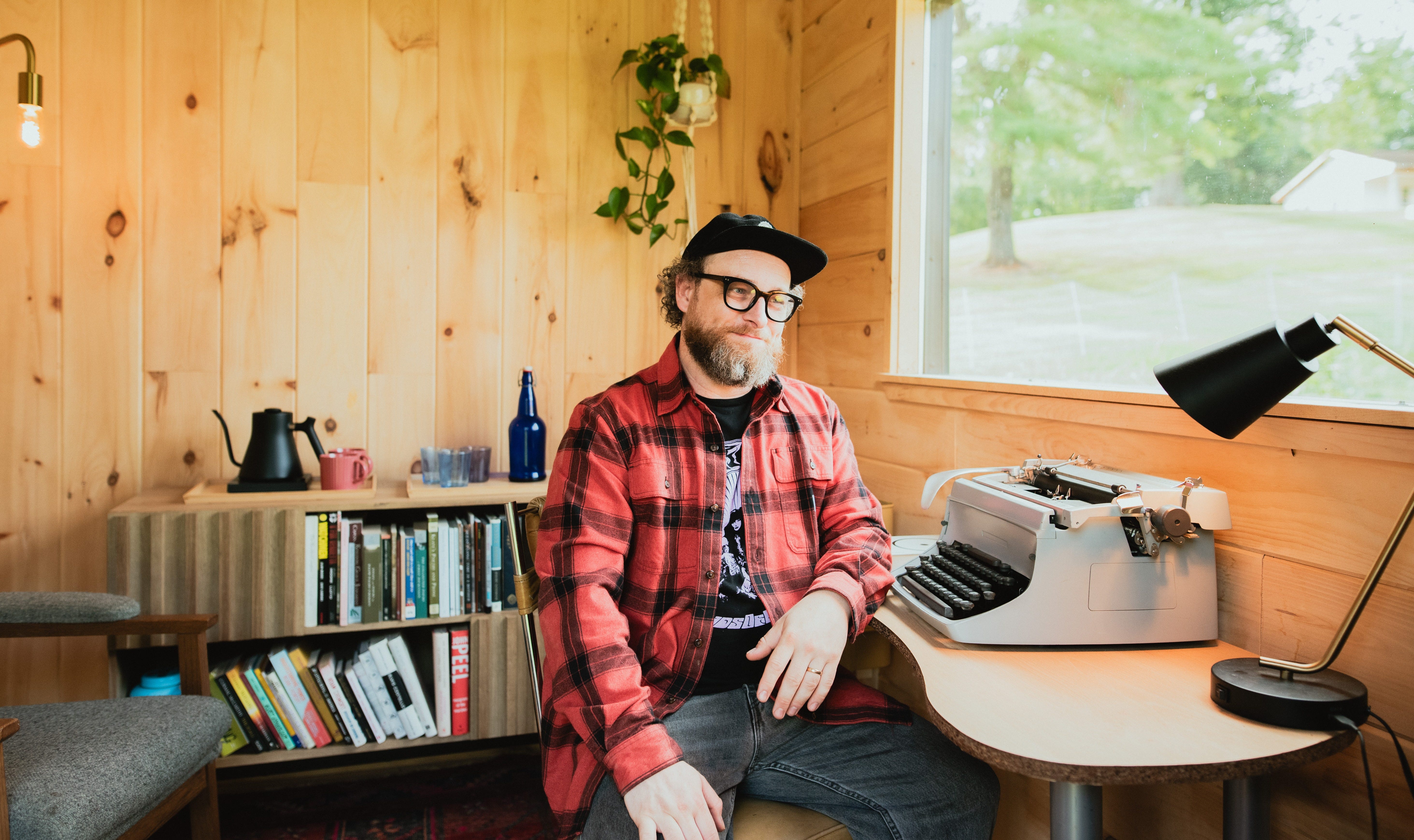
I found David Gate the way many others have: scrolling Instagram and stopping cold on one of his typewritten poems that said something I’d felt for years, but not been able to articulate.
That, I’d later learn, is precisely what David is going for.
Originally from London, David has lived in Western North Carolina for roughly a decade — drawn here, as many are, by the mountains and the flavor of life they make possible. He and his partner tend a one-acre homestead in Canton, raising rabbits and goats, and milling flour. David, 45, writes in a small, un-air-conditioned shed on their property.
After building a large and loyal following on Instagram, he landed a publishing deal with Penguin Random House imprint, Convergent Books. His debut collection, A Rebellion of Care: Poems and Essays, came out last summer. It’s a manifesto to embrace our collective humanity — to live and love, fiercely and fully — in an age of social unrest, hyper-capitalism, and pervasive isolation. He tackles topics like grief, burnout, and spiritual resilience with radical tenderness and honesty, and a dash of snark.
I pre-ordered A Rebellion of Care and have read it multiple times, keeping my hardback copy in my backpack to easily revisit during quiet moments on the go.
David’s journey to becoming a published writer now making his living off his words — via music, church ministry, fatherhood, and a painful but fruitful stretch of unemployment he describes as a kind of creative crucible — has been one long, nonlinear arc toward permission.
Permission to write what he wants, in whatever form it wants to take, and to trust that the work will find those who need it.
I met David one morning last week on the shaded patio of Rowan Coffee in West Asheville for an illuminating conversation about his path and process, as well as the core principles that guide his evolving identity as an artist. We chatted about our mutual love of Radiohead and shared appreciation for the creative gifts of midlife, and how his tactile approach to the craft of writing first found a home online.
You were a songwriter before trying your hand at poetry?
Music was always my first love. As soon as I learned three chords on guitar at fifteen, I started writing songs. I’ve always had a writer’s instinct and have always wanted to create, make, and express.
I grew up in London at the height of Brit Pop — Oasis, Blur, Supergrass. But my lifelong love has been Radiohead. Emotionally, they’re my biggest influence. Lyrically, I’ve always loved Elvis Costello. He was the first artist to make me realize songwriting is a true craft that requires a high level of skill. Then Elliot Smith came along. I loved the simplicity of his early albums, and how his music can make you feel.
When did your gears start to turn more toward poetry and prose?
As I was writing songs, I’d accumulate a lot of lyrics that wouldn’t fit into a piece of music. I started taking poetry very seriously in my early thirties, mainly to improve as a lyricist. I’d been doing sports writing and had always blogged and written articles. And I wrote sermons when I worked for churches.
I gradually became disillusioned with how music was made, produced, and put out into the world. I just didn’t enjoy any of those processes, which entailed sitting in front of a computer screen, dragging tracks, and using plug-ins to make things sound “better.” Literally chopping up and turning everything into something different. When I turned forty, I decided to focus solely on processes I enjoy versus outcomes.
Do you see a clear line between poetry and songwriting?
They’re very similar, on the surface. But with poetry, there’s absolutely no room for cliché. There’s no music to carry your meaning. It’s only words, so you have to find ways to conjure emotion and meaning. And that’s both freeing and incredibly tough.
How do you decide on a medium for your words?
I feel it. Everything starts with an idea that interests me. I have to want to write and be interested in something for it to get finished. I eventually gave myself permission to do my own thing and not compartmentalize what my writing should be or where it should belong. I just started writing the things I wanted to write. For a long time, I didn’t even call myself a poet. My concept of poetry was a little too idealistic, too weighty, too artistic. I had to allow myself a little more freedom.
You started posting poems on Instagram in 2021. How did that come about?
My notes app was filling up with ideas, and I needed outlets for that creative energy. I thought, I have a phone and an Instagram account, so I just started putting things out. My account started to take off in 2022. I’d grown to what I considered a decent number of followers, but I hadn’t made a dime.
Then the fiber mill where my partner and I worked closed down, so we both lost our jobs at the same time. Broke and unemployed, I was scrambling and having a mental health crisis. We cleaned Airbnbs, and I set up a Patreon to see if anyone would pay for my writing. A couple of months later, I decided to sell my typed prints and did much better than I thought I would. I first bought a typewriter in my early thirties. I’d write little letters to people, little notes to friends, and I’d sometimes write poetry. It sat idle until my Instagram began to take off.
Why do you think there was an appetite for your work in that post-COVID season?
I think a lot of people were — and still are — exploring poetry. Some of it is Millennials aging into their late thirties and early forties, searching for meaning in midlife and finding some of that in poetry.
Did the positive response inspire you to write more?
Yeah. A huge part of writing is teaching your audience who you are and what you’re going to write. I really believe we get the readership we deserve, according to the risks we’re willing to take and how we establish ourselves as writers. I’ve always been keen to push my audience and pivot to write about different things.
Then there’s maybe fifteen percent that comes from learning from your audience. You realize what you’re good at from people’s responses and reactions, from seeing what takes off.
How do you straddle that line between serving your readers and preserving your voice?
The drive for me is always to get better at expressing myself. There are ways in which your audience can teach you how to get better, because we don’t see ourselves perfectly. Being open and responsive, and engaging with people’s reactions to the work, can help inform you about what you’re good at, where you can improve, and what you may want to avoid. Even the negative reactions sometimes tell you when you’re on the right path.
How does living on a farm and digging in the dirt serve your creative process?
I find it very helpful, creatively, to do things that take a certain amount of distraction to enter into — whether that’s sewing, gardening, or physical labor. Usually I’m listening to music or listening to a podcast, and I find that if I spent two hours doing that, I’ll come away with three or four ideas.
“I want to provide meaning and moral clarity. That’s my guiding light: what am I feeling, and how does that become words?”
Are you a disciplined writer? Do you have rigid routines?
I constitutionally want to write and feel more fulfilled when I’ve written. I enjoy the process. But I don’t always have something to write about, so I let my interest shape what I write. If something bores me, or I get stuck, I put it aside and move on. Some of that is an ADHD thing — keeping twenty things going at once, chipping away at all of them. But as long as I’m interested and keep going, the work gets done.
Instagram is where you first found an audience, which to me is an interesting juxtaposition considering social media is flooded with information and noise. But the purity of your writing somehow cuts through. Why do you think poetry works on the platform?
Ultimately, I think people are looking for a point of connection. And that connection usually comes from having your mind blown by something you didn’t know, or finding something that makes you laugh, cry, or become outraged. What poetry does best is give language for something you’ve always felt, but never had words for. Music and video have a tone or timbre that can make you feel a thing. But people walk around with aches and pains — things inside them they’re searching for language to express. I want to provide meaning and moral clarity. That’s my guiding light: what am I feeling, and how does that become words?
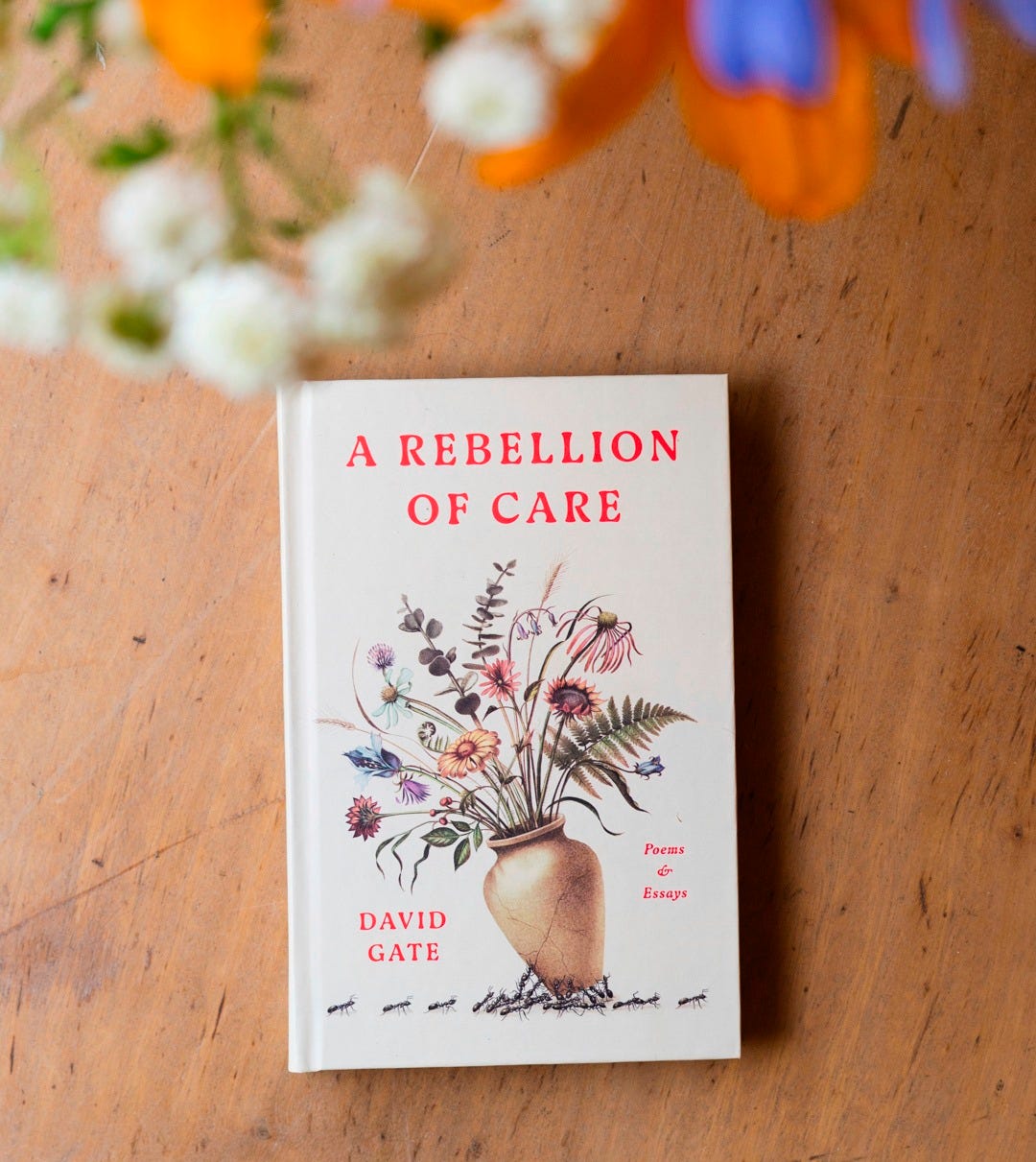
You didn’t originally want to include essays in the book? Why?
I wanted it to be a book of poetry. I didn’t want to do much explaining, because I felt like the poems did enough of that on their own. But we all agreed the chapters needed clarifying, because they had really distinct themes. Essays help express the poetry. My editors were completely right, and I knew it. I just had to accept it.
Was it hard to inject more of your story into the work?
I was very comfortable doing that in my poetry, but I didn’t really want to write personal essays. But now I’m actually saving a lot of the more personal things I’m writing for the next book, because I think they will work better there than on Substack. Plus, there’s a distance when you can’t see the likes or the comments, or the lack of comments. [laughs]
You’ve described your work as centering on ‘care for the individual and the nurture of community.’ When did you realize that was the animating idea under your writing?
It took taking stock of what I’d written in the first year. A lot of it was born out of whatever I was inspired to write about, and at first that felt kind of chaotic. I had a whole series of poems on friendship. I was writing about faith. I obviously care an awful lot about culture. I wrote a prose piece about the movie Everything Everywhere All at Once that really blew up, which I didn’t expect, because it wasn’t like anything else I’d written.
Eventually I stopped thinking too much about my writing in the moment. Once things were out there, I’d reflect: What ties all of this together? It’s care. It’s moral memory. It’s community. Particularly a high level of individual dignity held in tension with a deeply connective, communal spirit. I also was exploring my own changing faith and politics in that work.
The title frames care as a rebellion. What are you rebelling against?
I view it very deliberately as anti-capitalism, anti-hyper-individualism, anti-consumerism. My view is that system is killing our world and killing us — mentally, physically, communally. It’s a genuinely extractive way of being. So the rebellion element is wanting to break that down. And what replaces it? Care. Care as a guiding principle for how we do our politics, practice our faith, organize our communities.
How has the book changed your life?
There aren’t many people who can make a full-time living from writing books, and that includes New York Times bestsellers. It’s not really a sustainable thing to do unless you have a catalog. The goal was always to sell enough to do another one. What an amazing life to be able to go from book to book to book! That’s the life I want.
“I’m really kind of a propagandist in the way I see the world. I am not trying to be a fair and balanced writer… I feel a duty to the truth and to my own moral compass. And I feel a duty to my own creative drive.”
What can you tell me about your second book? Will it follow the same format?
Poems and essays again. Maybe slightly heavier on the essays, because I’ve really leaned into those and am really enjoying them. I also decided, once I finished writing the first book, to focus artistically on my Substack and give it a full day a week of my time. I take it really seriously. I love the weekly challenge of figuring out what to write about and how to present my ideas. I’m really kind of a propagandist in the way I see the world. I am not trying to be a fair and balanced writer. I’m also not a journalist. I feel a duty to the truth and to my own moral compass. And I feel a duty to my own creative drive.
You’ve talked about letting go of external validation — the ‘processes over outcomes’ mantra you landed on. How did that carry through the book launch?
I’m glad it happened at this point in my life rather than when I was 25. I could actually savor the moment, and none of it really caught me off guard. I was so keen to get the work out into the world. Publishing a book is an amazing outcome, but because I’m focused on processes, the outcome is not the goal. All I was really thinking about was enjoying the process of releasing the book, meeting people, and engaging with the readers. Even as an introvert, I love doing in-person readings and events, having conversations, and meeting the people who read my work. I’m exhausted afterwards, but I really enjoy it.
What does that engagement give you?
I grew up in an analog age and have spent so much of my life in church and communal environments, so it feels a little like coming home. In terms of online — as the account grows, you get way more comments and messages. I still have energy for it, because I remember what it was like in my late thirties. I was pretty anxious and depressed. Nobody cared two hoots about anything I was writing. Every avenue I was pursuing hit a dead end, and I was creatively frustrated. I remember what that was like. So, to have anyone care about my work, and particularly to have people who’ve been moved in significant ways, is an amazing gift.
I think if you didn’t feel that way, something would be wrong with you.
That’s part of the reciprocal nature. It isn’t about ego or the need to exist in people’s minds or in the public sphere to be validated as a human being. I’ve done enough therapy to know that doesn’t do it for me. But because I have communal, collectivist ideas, part of that means being engaged and part of a wider thing.
You can’t do that just in isolation.
No, you can’t. And you can’t extract it either. You can’t be the artist that just siphons attention to your own work. There has to be an element of giving for it to be really great work.
Where do you stand on the idea that artists need to suffer to make great work?
Total myth. Great work often comes from suffering — I won’t deny that — but you don’t need it. Suffering is not a requirement. And chasing suffering will not lead you to great work.
Similarly, it’s bullshit to suggest happiness can’t render a great song.
One of my all-time-favorite albums is [the Beach Boys’] Pet Sounds. There’s so much joy there. Melancholy, too. When writing something really happy, I try to remember that we’re all going to die. And when writing something sad or heartbreaking or angry, to not forget to find something beautiful or hopeful. Add a little salt to something sweet to make it taste better. I try to always have a little note of the opposite in there — a contrast that comes through and makes it feel more real.
You mentioned being ready for the book to come out in your early forties. That really resonates with me. I’m fifty-one and feel like I’m just now stepping into my voice as a writer, thirty-plus years into my career. Why do you think midlife is a fertile season for creativity?
I think it can be a real sweet spot. Because you’ve gained wisdom and insight about yourself and the world. You’ve accumulated skill. And it’s a period when your parents begin to age out and your kids are getting older. So there’s this feeling of both lost childhood and reckoning of: This is how I thought my life would be, and it’s nothing like that. You’re making conscious choices about how you want to spend the rest of your life. And ultimately, for a creative person — particularly a writer — you either embrace that moment or you let it kill you. Turn cold and cynical and numb, switch to pure survival mode. And all those other ways just seem totally untenable for me.
“I find I have way more success when I ask: How are my guiding principles, my philosophies, my artistic sensibilities shaping how I see this? That’s what I’m doing.”
Do you think you’d be where you are had you not hit that breaking point four or five years ago? Do you create well under pressure?
It was a very fertile year. Some of my most popular poems from the book — and ones that still sell the most prints — came from the second half of 2022. And they we not about what was going on. They weren’t about my mental health struggles or about being desperate. I also had a month — November 2022 — where I just decided to write and put out a poem every day. Ten or twelve of those ended up in the book. There’s something about doing a poem a day that frees you from having to think too hard about whether it’s the right thing to write, whether it’s going to be the one that pops.
How do you approach topical writing without becoming a talking head?
I try to harness the current energy without becoming reactive. Rather than pivoting toward what’s happening, it’s more like: I am grounded. This is how I’m processing what is happening in the world this week. Rather than coming up with a hot take. Outrage and reaction are the easiest things to do, but I find I have way more success when I ask: How are my guiding principles, my philosophies, my artistic sensibilities shaping how I see this? That’s what I’m doing.
That sounds more true to who you are.
And I think it makes for much better work. There are a lot of people reacting — and sometimes their reactions are particularly interesting or controversial — but I don’t find that’s the best writing. It comes back to what I try to do with poetry, which is find the words to express things people are thinking but don’t have language for.
Order A Rebellion of Care, hand-typed poems, prints, stickers and more at davidgatepoet.com. Find his poetry on Instagram at @davidgatepoet and his weekly essays at davidgate.substack.com.
Great interview.
What a fascinating read. I think all of our society may learn a thing or two from David Gate’s poems and writings.